Decreasing overhead. Adding profit to your bottom line!
What We Do:

The Cost Reduction Company (CRC) helps companies in Northeast Ohio reduce their overhead and as a result, increase their bottom line.
We do this by recovering unauthorized price increases, double billings, and invalid fees buried within existing invoices.
Text
A 10-person company can spend $40,000/year on these services. A 100-person company can spend over $300,000.
Our goal is to reduce these monthly expenses by 25% without changing vendors.
Alarm, Fax & Modem Lines
Copier Service
Credit Card Processing
Electric & Gas
Internet & IT Support
Mobile / Cellular
Office & Elevator Phones
TV, Video, and Music
Would an additional $10,000–$75,000 in net profit help your bottom line?
“Beware of little expenses; a small leak will sink a great ship.” Benjamin Franklin
How We Do It:

Our process is painless:
You provide the invoices.
We do the discovery, negotiation, implementation, confirmation, and monitoring necessary to reduce your overhead.
A: Discovery
1. Your current invoices give us what we need to begin breaking down your costs. You can provide any of the following:
Paper copies of each invoice for the past year. This will allow us to see if your costs are seasonal or the same each month.
Access to your online account with each service provider. This will also allow us to monitor and validate your costs ongoing.
A letter of authorization that will allow CRC to contact each of the service provider(s) on your behalf.
2. CRC will spend 1-3 weeks breaking down your existing expenses and contract terms; and developing our cost-saving recommendations.
3. Once complete, we will schedule a 30-minute meeting to go through these recommendations.
B: Implementation
1. Once we have agreed on which recommendations to pursue, a signed agreement will get us started on the implementation.
2. CRC will call each service provider to negotiate the new pricing and contract terms.
3. CRC will schedule, oversee, and test any recommended changes to your services.
C: Monitoring
1. Once the cost reduction measures have been implemented, CRC will begin to review your invoices each quarter to confirm and enforce the savings negotiated with each service provider for the 3-year term of the agreement.
2. Once the implementation is complete, CRC will begin to invoice quarterly for 1/3 of the actual savings to cover the cost of the discovery, implementation, and monitoring of your services for the term of the agreement.
3. If no savings are found, there will be no fee from CRC.
“Take care of the pence, and the pounds will take care of themselves.” William Lourdes
Pricing:

Our pricing is risk free:
If no savings are found, there is no fee.
If we are successful, CRC will invoice for 1/3 of the savings you receive.
"Dishonest money dwindles away, but whoever gathers money little by little makes it grow." Proverbs 13:11
FAQ's:

I have tried to answer the most common questions below.
Please reach out to me directly if you have additional questions or would like to discuss your situation directly.
1. Why do I need a specialist to reduce my overhead?
Each issue can take hours to find and 3-4 long phone calls to the service provider to resolve. Each call generally takes at least an hour, is answered by a machine (AI), and requires several transfers to get to the right department/person. This is a lot of time to spend on something that may not produce any savings.
When you finally do connect with a human being, your service providers will immediately start trying to sell you something else you do not need.
Without a clear understanding of each service provider’s technical language and contract tactics, businesses can actually end up paying more, because some agreements allow the service provider to remove contracted discounts if changes are made to the services.
Finally, someone will need to oversee any changes to your service and review your invoices each month to verify the promised savings.
This overall process can take an experienced analyst weeks and months. An inexperienced person could spend a lot longer which adds up to more money spent on illegitimate charges, which could have been used to pay an expert to do this work for you.
2. Why should I hire CRC?
CRC is a local company that has been lowering costs for small business owners in Northeast Ohio for 25 years.
CRC will handle the entire cost reduction process for you, so you can use your time to grow your business.
CRC takes all the risk out of reducing your overhead, because if we don’t find savings, there is no fee!
CRC only charges 33% of the found savings, as compared to national competitors who charge 50%.
3. How can a small business keep costs under control?
Conduct Regular Expense Audits
Optimize Vendor Negotiations
Reduce Unnecessary Expenses
Improve Inventory Management
Automate Financial Tracking
Leverage Outsourcing When Needed
Implement Energy-Efficient Practices
Streamline Operations & Reduce Waste
Monitor Key Performance Indicators (KPIs) & Adjust Accordingly
Encourage a Cost-Conscious Culture
4. How do service providers manage to increase their pricing without telling you?
When a provider offers service without a contract, it's not for your sake. It means they can change their pricing at any time. Guaranteed pricing without a written contract is not guaranteed.
Even with a contract, when you remove or downgrade services, the small print typically says that your provider can increase their pricing.
Unlimited usage is not unlimited. Most wireless providers use the term "Unlimited" in the name of their offerings. Most of these are unlimited talk and text, but not unlimited data. If you call in for service, the provider typically incentivizes their service personnel to sell additional services, and they often times do so without making it clear that these services are not included in your current pricing.
Simple fraud explains many price increases. When a provider incentivizes their sales people to sell products that customers don't need or want, it is not uncommon for them to show up on the customer's invoice.
Being talked into something you don’t need by a commissioned salesperson is another likely occurrence. This is especially common when the customer is unfamiliar with the technical language or without the technical ability to measure what is actually being provided. For instance, when a salesperson recommends more Internet bandwidth, it is very difficult for the customer to know if received it or if this is something they really need.
5. How do you know what you are actually getting when you don’t understand their technospeak?
Before speaking to the vendor, write down the real-world problems in your business that you would like them to solve. Include how this problem impacts your business and what success would look like. For example, Problem A is causing shipping delays, and you would like to decrease the average shipping time from 2 days to 1 day. By providing this information, you will get more direct and honest feedback from the vendor as to whether their solution is a good fit.
If a term is unclear, request a simple, non-technical explanation. For example, if a vendor says something like “we leverage the latest blahblahblah,” ask them how blahblahblah would help you achieve the shipping goal problem listed above? Don’t just trust the vendor’s word it. Make them translate their jargon into business language that you understand. If you are not confident with their translation, use a 3rd party expert who can translate it for you.
If you are working with a salesperson (who is incentivized to convince you that their products can do everything you need), request a meeting with their engineering team or even better their service team to answer the questions above.
In the contract, clarify deliverables, timelines, and performance expectations. Include clauses for service level agreements, cancellation, and renewal terms so you know exactly what you’re getting.
Get multiple competitive bids and ask each bidder why they think their product would be better than the others in solving your business problems.
6. How do you know if a company is actually qualified to deliver the service you want?
Rely on experience, not marketing. With today’s technology, anyone, and I mean anyone, can have a website that says they are experts at everything, even if they have never delivered a single solution in this area of expertise.
Get referrals from businesses you know who use the service you are looking for. References provided by the service provider are never going to be anything less than their favorite customer (possibly a brother-in-law who pays 50% less than what you would pay.)
Ask the vendor if you can talk to a real customer who is using their service to solve the problems you have listed above. If they cannot recommend another business for this purpose, think hard about moving to the next vendor, or at a very minimum, ask for a free trial of their service so you can see for yourself if it is going to work in your business.
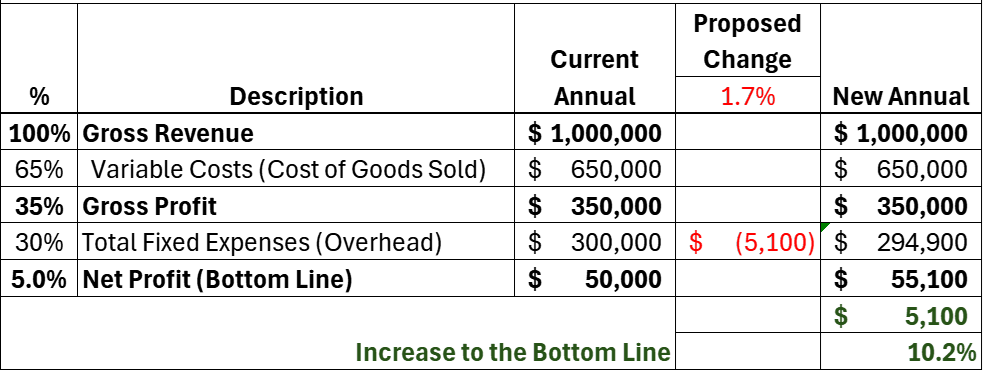
Reducing overhead by 1.7% could increase your bottom line by 10%!
About

Christian Fedor, Owner
For 20+ years I helped business owners reduce their overhead so they could afford to upgrade their business technologies. Today, I help them reduce their overhead to simply increase their bottom line. Same skillset, slightly different goal. I would love the chance to help you keep more of your hard-earned money as well.